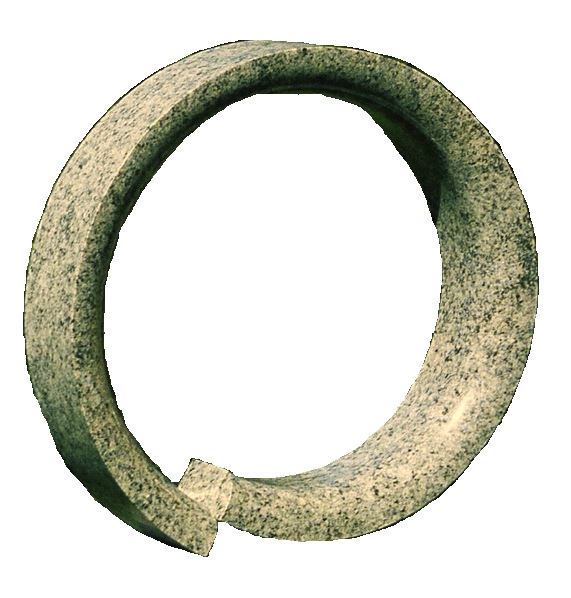
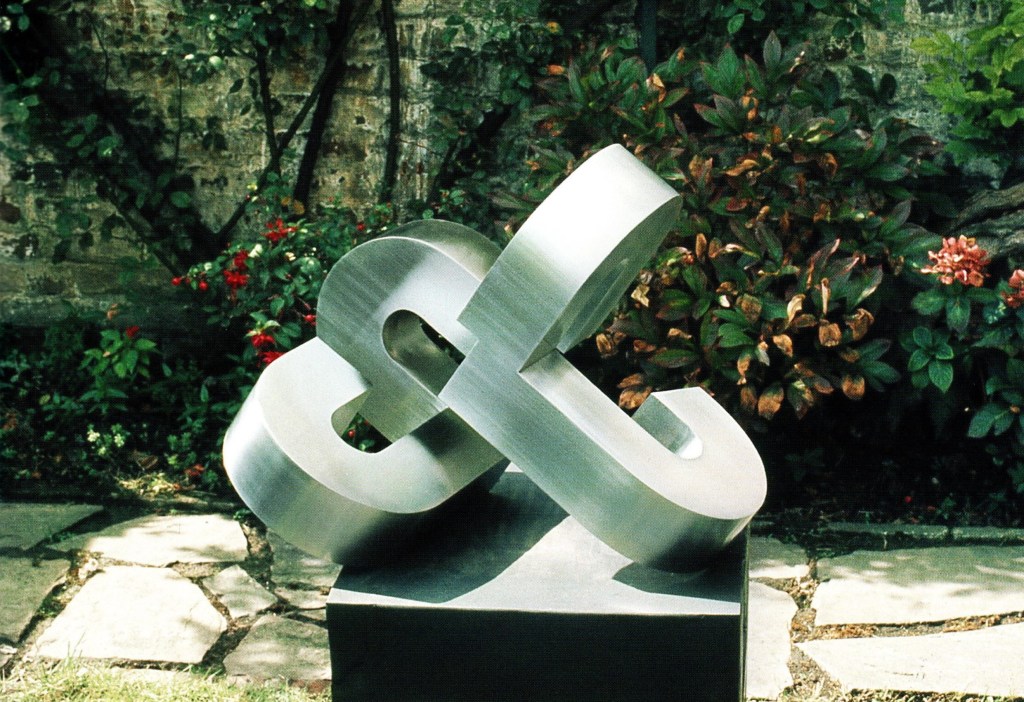
A fundamental aspect of Crovello’s art is revealed in the polished surfaces of his sculpture and in the smooth design of his images. This is certainly not spontaneous but has been researched and thought out. His are conscious decisions: not to let the images he has created be dispersed in a wave of expressionism nor to be seduced by the narrative mode. But, one will say, Crovello is an abstract artist therefore anti-naturalism, anti-narration. I do not think that Crovello’s sculptures can be understood as iconoclastically abstract, they do not have the acerbic programmatic vehemence of that kind of abstractionism. I refer here to the now “old” theories of abstractionism which go from Malevich to Mondrian. On the surface his work is decorative and “minimalist” (allow me this contradiction in terms). I rather see in Crovello’s hand a guarded desire to communicate to the viewer the inner story of each image. The transformation of simple and at the same time complex lines going from the plane to three dimensional forms.
The are ideas which are frequently expressed but still satisfying. Crovello follows a clear and coherent path which he has established for some time. Today’s art world enjoys an unbiased eclecticism, sometimes a violent one (will this violence be the last frontier of experimentation?). Sculptures such as Crovello’s reach the extreme limits of the artistic horizon, as far as our eyes can see. Perhaps because of their professional quality, even more so because of the artist’s attitude in wanting to keep a high moral profile in his work. Indeed from his sculpture comes forth the clear science of geometry (Euclidian I once said and repeat now) and the transformation into volumes is realized in noble and elaborate materials.
It is useful to underline the fact that Crovello lived for four years in Tokyo studying Japanese calligraphy. These studies seem to be an essential element of his science: calligraphic rhythms imposing a delicate movement to the plastic masses generated by them. They seem to graze lightly over symbologies of various cultures, uniting them. Above all they infuse a subtle life to cold and rational geometric schemes. Forms in his sculpture are sealed and refined. They do not reflect a painful enigma. Crovello seems to say a work of art is a place for meditation and for measured, reserved enjoyment.
Bruno Mantura, Rome, July, 1996
 WILLIAM CROVELLO (1929-2021)
Leave a comment