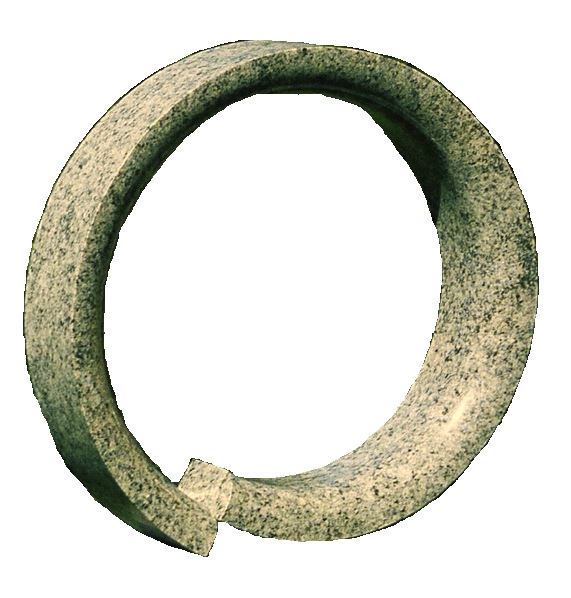

In a time of artistic globalization when all is finally permitted the objectively aesthetic impact of Crovello’s “perfect” sculptures should not perplex us. Even less should we worry about possible hedonistic motives.
A citizen of the world for having traveled widely, the goal of the American sculptor does not seem to originate in the appearance of the work, but has its origins in the signs that sustain it. The resulting beauty therefore, being somewhat implicit in the creative gesture, is the product of a combination of impulses, archetypical of the sign-gesture transformed into abstract forms, geometrically abstract, which in effect assume aesthetic connotations, spontaneous as much as premeditated. Transmitted from Asian philosophies which only a few initiates are able to realize and understand and above all to express in a plastic medium. Consistent with the intellectual creative itinerary, the title of a sculpture is given by the artist at the conclusion of the work and is unrelated to the original hypothesis.
Crovello, not participating nor referring to specific artistic movements, has a sort of cultural “manifesto” to which he returns constantly: a 1931 text of G.B.Sansom in which the author explains the Japanese aesthetic relating to the practice of calligraphy. He describes it as a “…powerful influence which tended always to restrain and purify…” and which (calligraphy) “…may be the symbols of ideas, but they are not pictures of things…”. In fact who “…takes up his brush to trace them is not distracted by any desire to represent or even to suggest a concrete reality but aims at making shapes whose beauty is their very own…” Precisely in these phrases is revealed a concept in which beauty does not exist unless derived from an original and special gesture such as that of calligraphy, born in a world of “pure form”, which aims at finding forms of intrinsic beauty. This insistence on Japanese culture combined in Crovello with an uninterrupted nomadism lets him know people and countries of many continents. Four years in the U.S. Air Force allowed him to visit Korea, Japan, Taiwan, the Philippines. Thailand and Vietnam. And afterwards Turkey, Greece, Italy, France and Spain. This last country is where he began to work in marble and metal. The first monumental work, in metal, created in New York, is in front of Radio City on Sixth Avenue (Note: It is now at the Berman Museum of Ursinus College in Pennsylvania). In the early ’70’s he lived in Brussels and then went to Finland where he worked on other monumental pieces. In 1977 he returned to live in NY but his wandering takes him to Italy to look into the famous quarries of Carrara. There he and his wife under-went a long search for a house which, once found, was restored. A magnificent ancient building situated, not by chance, above Pietrasanta. He spends many months of the year there and has kept a loft in N.Y.
So, a solid multiculturism with particular emphasis on Asia, has been based for some years in La Versilia, one of the places in the world privileged by nature with its stone deposits, which Crovello has for many years chosen as the center of his world.
Returning to calligraphy we should explain how the American artist came to be attached to this genuine art. Back in 1956 he studied Japanese language and culture at Columbia University for two years and at the same time learned the rudiments of Japanese writing from the artist Guen Inokuma who was then living in New York. The fascination of this art was such that he soon moved to Tokyo for four years and studied calligraphy in depth with the master Taiun Yanagida. It should be remembered that the artist had trained as a painter and graphic artist and continued this activity until 1977 when he came to work in Italy. He first worked in sculpture, however, in Spain in 1968.
Since then his energies have been divided between large outdoor sculptures of pronounced geometric and modular forms and indoors work, more elegant and pleasing. Almost sonorous plasticity of archetypal origins. Thus from the word, imaginary, sometimes traced out, to the form, to the type of stone to be carved, smoothed, polished, Crovello realizes a sculptural calligraphy which can adapt to any dimension.
In 1979 writing for the Danish journal of art “Cras” (no. XXII) based on his experience Crovello defines some of the aesthetic parameters of monumental sculpture and also of those for enclosed environments. Regarding scale he underlines the need to carefully judge the relationship between the size of the work, the human module and the site. Regarding the image itself, also in relation to size, he notes the existence of an “…innate dimension…” which determines the real one. Regarding site he notes a clear distinction between outdoors and indoors, not only for its relation to its surroundings but for the consequent personal or collective fruition. The latter being mediated and influenced by other human beings or by other circumstances. He concludes by asserting that with sculpture one must make exchanges and choices: either isolation for a very personal fruition or the sculpture destined as an actor on the world stage. Less personal but more gratifying (to the group).
However fundamental, the “philosophic” reference to Japanese calligraphy does not exclude assonance with the period of American minimalists of the middle ’60’s, which gave birth to monumental sculpture, influenced in turn by the abstract geometry of Brancusi. But these are only references in Crovello’s work. Especially for those destined for enclosed spaces. The choice of richness and singularity of material, natural colors and their matrix, probably retained from his painterly taste, are fundamental. While industrial products of no intrinsic value were notoriously sufficient for the historical minimalists.
The artist does not like to speak of his long period as a painter. But in this Florentine exhibition are shown many drawings from the ’60’s. Particularly those with a direct link to the study of Japanese calligraphy, and which are very revealing of the sculptural development starting in the early ’70’s. Pure conceptual gestures, but very controlled in their graphic continuity, elegance and the expressive strength of the abstract shapes. Embryos of symbologies of singular musical sonority and in some cases of complex cyclical scores. This is a different way of seeing Crovello’s sculpture. Perhaps just an extension of critical writings which have already appeared.
Crispolti in 1989 finds in the high finish of works in marble and various other stones a hedonism in the vein of a certain aesthetic interest but also transcending a particular minimalism which is largely indifferent to form in outdoor sculpture, although a specific “plastic design” is present.
Cordoni, in 1996, denies plastic choices in Crovello’s aesthetic, pointing out a system of signs expressed in plastic forms of cosmic-dynamic inspiration and calligraphic signs of Oriental origins.
Bruno Mantura, also in 1996, writes of Crovello’s anti-narrative sculpture because the artist himself is an abstract anti-realist and certainly minimalist, while discovering an “inner story” in each image obviously going back to Japanese calligraphy.
Deepening a reading keyed more to a plastic musicality than the visual, and even more inside the artist, one can find in the harmony of the original sign as brought forth in the work a symbolic definition of unknown musical notes or of their scores. Cyclical motifs such as these are revealed above all in the columns. Often smooth, at times rough, or smooth-rough or with markings on the surface as in the case of “Waro”, a modulated column of 1989 in black African granite. Work which can be placed in a line with “Keisaku”. The name of a series of related sculptures with accentuated verticality, variously modulated, in which shadow and light also play a role. We see a strong variation “Katsu”, which in Japan signifies the action in calligraphy of drawing a strong vertical line, an action Crovello wanted to bring to the extreme limits of paradox by transferring it to sculpture. From the softness of paper marked with the fluidity of brush and ink to the realization of a slender stele, wonderfully realized in a very hard black granite.
This is the case with “Katsu” 1994-98, 217 cm high with a base. And of “Katsu” of 1991-92, 205 cm high, more significant because it was conceived to be attached to a wall, analogous to the line marked on paper.
Not lacking in the American artist’s repertory are digressions towards the ironic and the playful. As in “Red Kiss”, 1988, in red Brazilian granite, or “Majita” of 1996, or the pseudo references to decorative Italian Renaissance elements as in “Twin Valentine”, 1974, in Portuguese granite, or, finally, the historical-architectural as in the elegant “Pisanella”.
To complete an overview of the expressive development of Crovello we must take note of some other sculptures such as “Mezcala Cube”, 1989, in black African granite. A solid geometric form, rough skeleton, showing its origins but in some way the antithesis of the “perfection” of other works. Recalling a Heraclitian cycle that can not be interrupted. Of the same order are the marble reliefs of recent years such as “Marble Relief (Square/ Triangle)” in Carrara statuario of 1998. There the elementary geometric figures are really symbolic, also, of the archetypical forms from which comes the plastic intuition of the artist.
In all these varied but coherent qualities this American artist shows an unbroken firmness of compositional rigor nourished by recurrent references to the origins of his aesthetic oeuvre.
Perugia – Cortina d’Ampezzo, July-August 2002
 WILLIAM CROVELLO (1929-2021)
Leave a comment